Is your original door seal no longer available? That's not a problem. There are hundreds of different refrigerator and cold room seals. An exact OEM match is not always available, but with our assortment and the step-by-step plan below, you will almost always find a suitable alternative.
Go directly to:
Search by brand: the fastest first step
Due to the import of refrigeration units from outside Europe, a proliferation of profiles has emerged. With our brand search function, you can immediately see which (alternative) profiles are already known per brand.
Haven't found a match? Then follow the step-by-step plan to select an alternative profile.
An alternative push-in profile in 4 steps
Are you unsure if you have a push-in profile? First, check the characteristics on the product page.
1. Push-in arrow
1.1 Width (tolerance ±1 mm compared to original)
- Choose profiles with comparable push-in arrow width (±1 mm).
- Expert tip: a hollow push-in arrow without thickenings provides more flexibility when mounting in the groove.
- Material/flexibility: if the profile material is flexible, you can often apply +1 mm wider. These are the profiles with extensions -MS, -AS, -ME, -AE (e.g., 195-ME).
1.2 Space (anchoring in the groove)
- Too small: arrow does not fit or does not remain anchored.
- Too large: profile moves in the groove, resulting in a shorter lifespan and can detach from the door or drawer.

2. Working height
Purpose: bridging the space between the cabinet edge and the door.
- Refrigerator drawers: an exact working height is not relevant for alternative seals in drawers. For doors, this is important due to the hinge.
- Never higher than the original: the profile will bind or deform on the hinge side, which may prevent the door from closing properly. This can sometimes be remedied by adjusting the hinges, although this is not possible with every refrigeration unit.
- Lower than the original is allowed in two cases:
- Up to 1.5 mm lower, provided a strong magnetic strip is used. The width and attraction force of the magnet and the expansion properties of the profile determine whether a gap of up to ±1.5 mm can be bridged.
- Up to 2 mm lower with a highly flexible alternative (extensions -MS, -AS, -ME, -AE, for example, 195-ME).
3. Magnet position (only for magnetic profiles)
The magnet must close against the cabinet edge. With a different magnet position, there may be no metal to attract to.
- Positions: outside (most common), middle, inside.
- Expert tip: pay attention to mirroring of cross-section photos and drawings. In all our drawings, the left side of the profile is the outside of the door seal once it is installed in the door.
4. Profile width
Choose an alternative profile that is equal to or smaller than the original in terms of total width. Check two distances from the push-in arrow:
- Arrow on the inside: the alternative must be equal to or narrower, otherwise there may be insufficient space for installation.
- Arrow on the outside: the alternative must be equal to or narrower, otherwise the profile will protrude. This ensures that the seal does not function optimally and is also not an aesthetically suitable solution.
Still haven't found a match?
Then we will help you! Send us a clear photo of the cross-section of the profile, preferably along with a physical piece of the door seal you want to replace. This way, we can compare 1:1 with our complete assortment. Contact us.
Testing with a physical sample
For professional maintenance technicians in refrigeration, facility management, and commercial kitchen technology, a sample case is available with more than 100 test pieces of refrigerator sealing profiles. This clear case prevents errors and additional customer visits when replacing seals for refrigerator doors and drawers.
In 3 steps to an alternative flat, bead, or hollow profile
Are you unsure if you have a flat profile, bead profile, or hollow profile? First, check the characteristics on the product page.
1. Profile width
Choose an alternative profile that is equal to or smaller than the original in terms of total width. Check two distances from the push-in arrow:
- Arrow on the inside: the alternative must be equal to or narrower, otherwise there may be insufficient space for installation.
- Arrow on the outside: the alternative must be equal to or narrower, otherwise the profile will protrude. This ensures that the seal does not function optimally and is also not an aesthetically suitable solution.
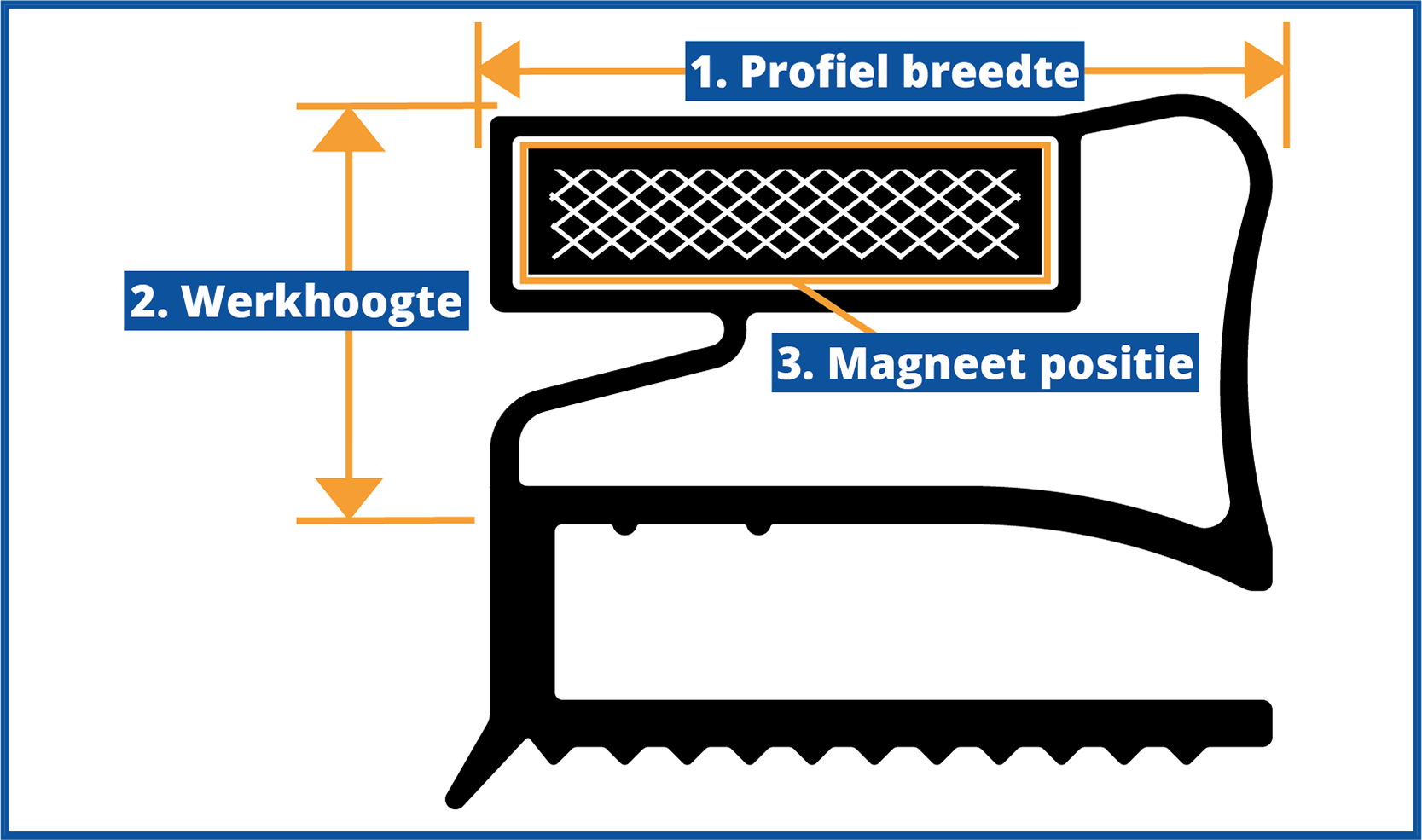
2. Working height
Purpose: bridging the space between the cabinet edge and the door.
- Refrigerator drawers: an exact working height is not relevant for alternative seals in drawers.
- Never higher than the original: the profile will bind or deform on the hinge side, which may prevent the door from closing properly. This can sometimes be remedied by adjusting the hinges, although this is not possible with every refrigeration unit.
- Lower than the original is allowed in two cases:
- Up to 1.5 mm lower, provided a strong magnetic strip is used.
- Up to 2 mm lower with a highly flexible alternative (extensions -MS, -AS, -ME, -AE, for example, 195-ME).
3. Magnet position (only for magnetic profiles)
The magnet must close against the cabinet edge. Positions: outside (most common), middle, inside. Pay attention to mirroring of cross-section photos: in all our drawings, the left side of the profile is the outside of the door seal once it is installed in the door.
Still haven't found a match?
Then we'll help you! Send us a clear photo of the cross-section of the profile, preferably along with a physical piece of the door gasket you want to replace. This way, we can compare it 1:1 with our complete assortment. Please contact us.
Testing with a physical piece
For professional maintenance technicians in refrigeration technology, facilities management, and commercial kitchen technology, a sample case is available with over 100 test pieces of refrigerator sealing profiles. This organized case prevents errors and additional customer visits when replacing seals for refrigerator doors and freezer drawers.
Frequently asked questions about an alternative door gasket
Yes. DSU produces everything to measure, even if the type number is not known to us. Determine the correct alternative profile using this step-by-step plan and configure your order with the exact dimensions.
Then choose the profile that comes closest according to the tolerances in this step-by-step plan, and never a profile that is higher than the original. Are you unsure? Send a photo and possibly a physical piece to our customer service.