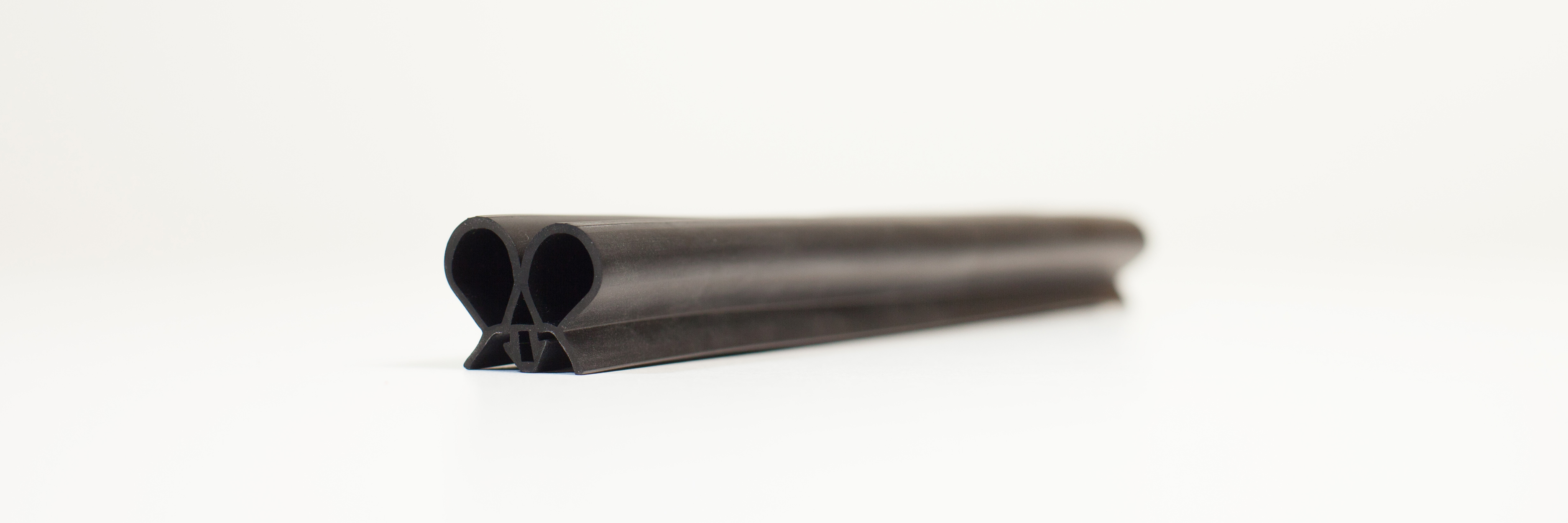
A rubber gasket is a door gasket made of rubber or EPDM, instead of the common PVC. Due to these material properties, it is often used in cold rooms, freezer rooms, and walk-in coolers. Rubber gaskets are available per meter or on a roll. For some rubber gaskets, corner pieces are also available; these have -H in the product name.
Rubber cannot be welded. For door gaskets ordered per meter, you therefore glue the corners yourself to the corner piece with rubber adhesive. For some profiles, we can also vulcanize the corners: in this process, the corners are joined together in the factory, allowing you to order a ready-made door gasket for these profiles that fits directly. Vulcanization is a time-consuming and specialized technique and is therefore not possible for every profile. Whether vulcanization is available for your profile and what minimum order quantity applies, you can see in the calculator tool.
Need help finding the right rubber gasket?
Not sure which profile you need? Search by brand and model of your refrigeration unit or compare the profile code with your existing door gasket. Once you have found the correct profile, you can use the configurator to specify both the color and dimensions to calculate the price directly.


How does a rubber gasket work?
A rubber gasket with a flap is installed in the same way as a flat profile. If the profile has a push-in arrow, the installation method is similar to a push-in profile. Some profiles need to be secured with a mounting strip. Rubber cannot be welded, so always repair or replace loose meters with rubber adhesive.
There are different ways to create a neat corner connection. You, as the installer, decide which method is best suited.
View the instruction videos for all different attachment methods for rubber gaskets here.
When replacing, always check the old profile code or the exact dimensions, so that the new profile has the same fit and seal. You can use the page door gasket dimensions for this.
Where are rubber gaskets used?
Rubber gaskets are mainly used in cold rooms, freezer rooms, and walk-in coolers. Rubber and EPDM are wear-resistant and suitable for low temperatures. This makes this material extremely suitable for heavier applications.
Find the right rubber gasket
DSU supplies rubber gaskets in a large number of sizes, per meter or on a roll. For part of the assortment, matching corner pieces are also available (-H). You can search by brand and model of your equipment to find the correct profile. If the correct profile is not listed, also check the category silicone gaskets. This is because there are profiles included here that are similar in shape to rubber gaskets.
How to compare the right profile
The most important factors for choosing the correct rubber gasket or a suitable alternative are the working height and the width. The working height is the part that is not under the plate/mounting strip. If the working height deviates too much, the door will not close properly. There will be a gap or the door will not close.
In the drawings on the website and in the catalog, the left side is always the outside of the profile once it is incorporated into the door gasket.
Frequently asked questions about rubber gaskets
Rubber gaskets can be recognized by the material: rubber or EPDM instead of PVC. If it's a large door, such as for a walk-in cold room, walk-in freezer room, or a sliding door, then it's likely rubber. The clearest difference is in the wall thickness of the profile: rubber gaskets (and silicone gaskets) are much thicker and relatively large or bulky compared to PVC and TPE profiles. Rubber gaskets are supplied per meter or on a roll and come with a flap (installation like a flat profile) or with a push-in (installation like a push-in profile). Corners are almost always glued, not welded (fused).
For some rubber gaskets, matching corner pieces are available, identifiable by -H in the product name. These are used to neatly and airtightly finish the corners of the seal. If no corner piece is available, you can make the corner yourself. We provide some examples of corner connections in this video. As an installer, you decide which one fits best.
Rubber cannot be welded. For this, use rubber adhesive to glue profiles.
Then look for a suitable alternative profile with the same working height and width. See the explanation on Search for alternative profile. In doubt? Feel free to contact us, and we will find the right solution together.
If it can be custom-made, measure the outer dimensions or from indentation to indentation. If it cannot be custom-made, order the number of meters of the circumference. Good to know: we only supply full meters. If you need 5.5 meters, go for 6. Also order the corner pieces immediately for the best result. You can easily glue these with the rubber adhesive.
Yes. Because the door gasket is pressed into the groove instead of being screwed or glued, replacement can usually be done without tools.
At DSU, we have over 900 brands; unfortunately, there are a multitude of type numbers, and new models are continuously entering the market. When the type numbers are known, they are listed on the brand's page. If the type number is not known to us, that's not a problem. We custom-produce everything. Determine the correct profile and size and use the configuration tool to create the order. Optionally, add the brand and type number to the reference so we can further complete our information.