A push-in profile is a door gasket recognized by its push-in arrow: a pointed edge on the inside of the door gasket that is pressed into the groove of the refrigerator or freezer door. The barbs on the arrow clamp firmly into the groove, ensuring the door gasket stays securely in place.
It is the most common type of door gasket for refrigeration and catering equipment. Most push-in profiles typically have an integrated magnet, identified by the addition of -M in the profile code. Do you need a door or drawer without a magnetic closure? Then profiles without a magnet are also available, indicated with -A or -R.
Need help finding the right profile?
Not sure which profile you need? Search by brand and model of your refrigeration unit or compare the profile code with your existing door gasket. Once you have found the correct profile, you can use the configurator to specify both the color and the dimensions to calculate the price directly.


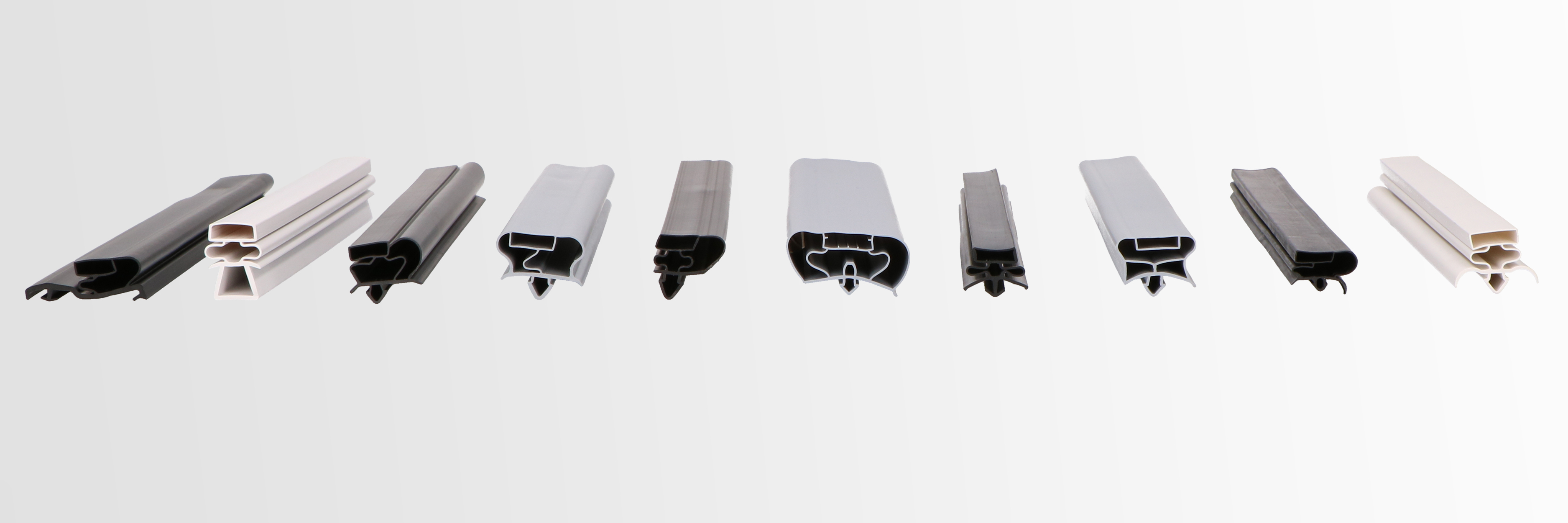
How does a push-in profile work?
European ecodesign regulations require manufacturers to make door gaskets replaceable with common tools, making the push-in profile the new standard.
The push-in arrow on the inside of the door gasket is pressed into the rabbet (the groove in the door or drawer). The barbs ensure that the profile stays in place, even with frequent opening and closing of the door. This makes push-in profiles relatively easy to replace yourself, without tools for screws or extra gluing.

With or without magnet
- -M: profile with standard integrated magnet. Ensures a good seal against the door frame and is the most common version.
- -A or -R: profile without magnet. Used when the door or drawer does not use a magnetic closure or when another closing method is required.
When replacing, always check the old profile code or the exact dimensions so that the new profile has the same fit and closure. You can use the door gasket dimensions page for this.
Where is a push-in profile used?
Push-in profiles are used in refrigerators, freezers, cold rooms, and drawers. In other words, in all types of refrigeration units where the door or drawer has a hard plastic groove to press the door gasket into. This is in contrast to, for example, flat profiles and beaded profiles, which are clamped and screwed.
Find the right push-in profile
DSU supplies push-in profiles in a large number of sizes and designs, with and without magnets. You can choose from three materials:
- Standard PVC (-M/-A/-R)
- Soft PVC (-MS/-AS)
- Extended Life TPE (-ME/-AE)
In addition, profiles are available with an option for an extra strong magnet. You can filter by material and design or search by brand and model of your equipment.
How to compare the right profile
When comparing profiles, pay attention to the width and height of the profile, the dimensions of the push-in arrow, and on which side the magnet is located. In the drawings on the website and in the catalog, the left side is always the outside of the profile once it has been integrated into the door gasket.
Frequently asked questions about push-in profiles
Look at the inside of the door gasket. If there is a pointed edge or arrow with barbs that clamps into a groove in the door, you have a push-in profile. If the door gasket is clamped around the edge of the door or screwed on, it is a different type of profile.
The addition -M means that the profile has an integrated magnet. The additions -A and -R indicate that the profile does not contain a magnet. Furthermore, -MS and -ME indicate the material: -MS stands for Soft PVC, -ME for Extended Life TPE. This is relevant because you want to maintain the same version as the original profile when replacing, unless you intentionally want a different version.
Then look for a suitable alternative profile with the same working height and an arrow in the same place as the original. View the explanation here. In doubt? Feel free to contact us, and we will find the right solution together.
Push-in profiles are used by many different manufacturers of refrigeration equipment. The correct profile depends on the exact dimensions and groove shape of your door or drawer, not just the brand. Therefore, preferably search by brand and model, or measure the existing profile and compare it with our drawings.
There are three ways to do this. You measure the outer dimensions, the distance between the outer edges of the magnetic strips, or from push-in to push-in. We have a handy explanation with photos or an instruction video for this.
Yes. Because the door gasket is pressed into the groove instead of screwed or glued, replacement can be done in most cases without tools.
At DSU, we have more than 900 brands, unfortunately there is a multitude of type numbers and new models are constantly entering the market. If the type numbers are known, they are listed on the brand's page. If the type number is not known to us, that's not a problem. We produce everything to measure. Determine the correct profile and size and use the configuration tool to create the order. Optionally, add the brand and type number to the reference so that we can complete our information.