Glass door and sliding lid profiles ensure smooth guidance, good gap sealing, and controlled damping of sliding lids and glass doors in freezer chests and refrigeration units. They prevent warm, humid air from entering the freezer. This limits ice formation, which in turn keeps energy consumption low: an ice layer acts as insulation and hinders cooling, forcing the compressor to work harder.
Freezer chests can be found in supermarkets, petrol stations, and amusement parks, among other places. Due to intensive use, guides, seals, and dampers wear out over time. Timely replacement ensures that the sliding lids continue to operate smoothly and the freezer remains efficient.
Need help finding the right profile?
Not sure which profile you need? It's easy to determine with this assortment. The hard plastic strips have a fixed length, matched to the width of your lid. The rubber dampers can be ordered per meter or per roll. Since there are not many different variants, comparing the profile height and width with your existing profile is usually sufficient to find the right match.


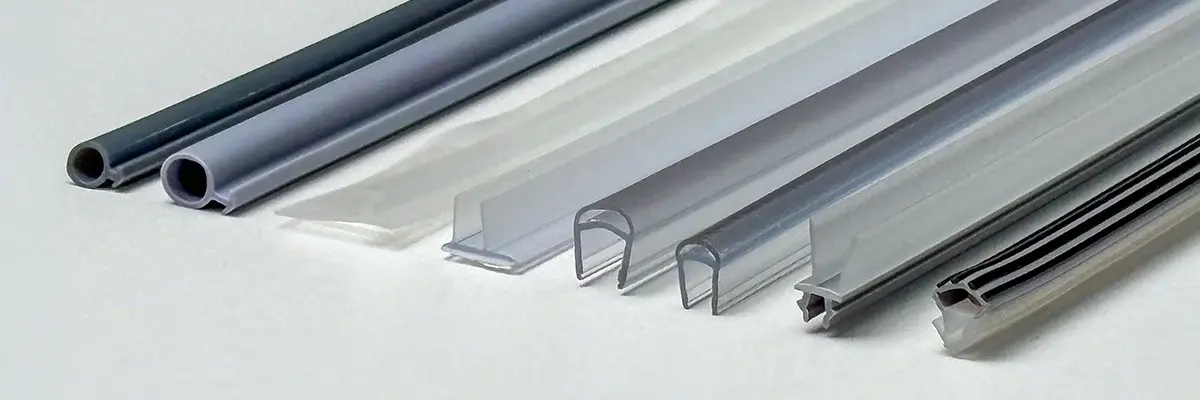
Profiles for sliding lids of freezer chests
Sliding pane guide (702-A)
A sliding pane must move smoothly and stably over the edge of the freezer chest. A sliding pane guide is used for this purpose. In our assortment, this is profile 702-A. For almost all AHT freezer chests with sliding lids, such as the AHT Miami and AHT Paris, 702-A is used in combination with 701-A. This ensures optimal guidance and sealing, and you can easily replace both parts simultaneously when they show wear.
Gap seal between the sliding panes (700-A and 701-A)
Where two glass sliding lids move over each other, a gap is created. A gap seal prevents warm, humid air from entering the freezer chest. Depending on the type of freezer chest, profile 700-A or profile 701-A is used for this. For AHT, 701-A is usually the standard in practice, in combination with 702-A. 700-A can be used as a universal seal for sliding lids because it is attached with double-sided tape.
Sliding pane dampers for the end side
Many sliding lids are equipped with a damping profile on the end side. This damping ensures a controlled closure and prevents excessive play during opening and closing. Various profiles are available for this, each with its own mounting method:
- 703-A and 704-A: are mounted with the arrow in a groove in the cabinet edge or on the sliding lid
- 721-A and 722-A: clamp around the glass plate
Profiles for glass doors of upright freezers and refrigerators
Damping profiles are also available for glass doors of upright freezers and refrigerators.
Damping at the top
For damping at the top of a glass door, the following profiles are generally used:
- 721-A
- 722-A
Damping along the long side
For damping along the long side of the glass door, these profiles are usually used:
- 60-SIL
- 66-SIL
- 705-AE
- 707-A
How to compare the right profile
When comparing profiles, pay attention to the width and height of the profile, and the dimensions of the pressure arrow (if applicable). In the drawings on the website and in the catalog, the left side is always the outside of the profile once it is incorporated into the door gasket.
Overview of applications and profiles
| Application | Profile |
|---|---|
| Sliding pane guide | 702-A |
| Gap seal between two sliding panes | 700-A or 701-A |
| Standard combination for most AHT freezer chests | 701-A + 702-A |
| Damping at the end side of the sliding lid | 703-A, 704-A, 721-A or 722-A |
| Damping at the top of a glass door | 721-A or 722-A |
| Damping along the long side of a glass door | 60-SIL, 66-SIL, 705-AE or 707-A |
Frequently asked questions about glass door and sliding lid profiles
These items come in a fixed length (this will be stated on the product page). The fixed length is matched to the maximum width of the sliding panes/chest. A strip is for one side of the pane. (e.g., most chests are between 90 and 122 wide. Our strips are then a fixed length of 122cm. You can cut them to size yourself with pliers/scissors.)
Alternatively, if the profiles are per meter/roll, then measure the total length you need.
Then look for a suitable alternative profile with the same working height and an arrow in the same place as the original. View the explanation here. In doubt? Feel free to contact us, and together we will find the right solution.
At DSU, we have over 900 brands; unfortunately, there is a multitude of type numbers, and new models are constantly entering the market. If the type numbers are known, they will be listed on the brand page. If the type number is not known to us, that's not a problem. We custom-produce everything. Determine the correct profile and size and use the configuration tool to place your order. Optionally, include the brand and type number in the reference so we can complete our information.
No, not always. Glass door profiles and sliding lid profiles each have their own function and dimensions. Therefore, always first check which profile is currently in the cabinet or sliding lid, and compare it with the profiles in our assortment before ordering a replacement.
That depends on the condition of the parts. If only the seal is worn, you can often replace it separately. In case of visible wear to both the seal and the guide, it is advisable to replace both parts simultaneously for optimal operation.