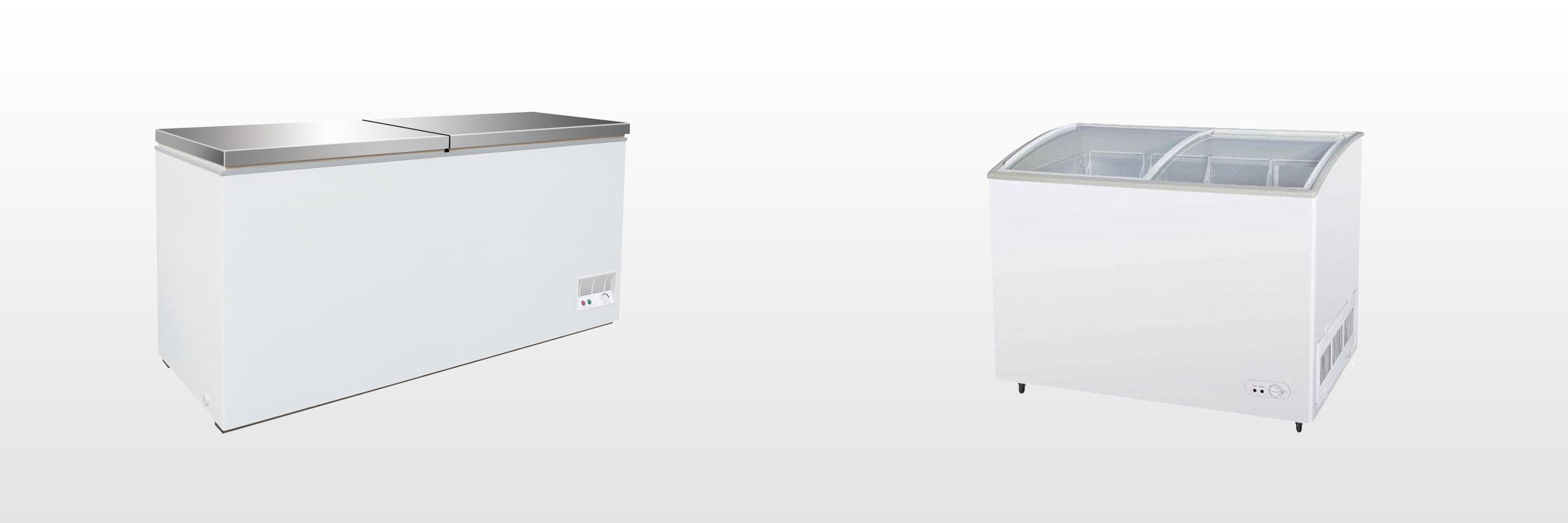
A chest freezer has a seal around the lid that keeps the cold air inside. Because the lid closes horizontally, the seal constantly rests under the lid's own weight. Therefore, a chest freezer seal usually does not have a magnet: the weight of the lid already provides the closure. Do you have a chest freezer with a glass sliding lid? Then take a look at our glass door and sliding lid profiles.
Jump directly to...
Types of chest freezer seals
Which seal you need depends on the type of lid of your chest freezer.
- Hollow profile: the most common type for chest freezers. A flap without a magnet chamber.
- Push-in profile: with a push-in barb that clicks into the rebate.
- Flat profile: a flap that is screwed, riveted, or stapled under a plate or strip.
- Bead profile: similar to a flat profile, with a bead at the end of the flap to prevent the profile from shifting during assembly.
Replacing a chest freezer seal? Keep this in mind
Are you in doubt whether your chest freezer's seal needs replacing? Pay attention to these signs:
- Does the seal show cracks or tears?
- Does the lid still rest evenly on the seal everywhere, without gaps?
A damaged seal allows warm, humid air to penetrate. In a chest freezer, this quickly leads to ice formation. This increases the energy bill and accelerates wear of the refrigeration compressor.
The right profile starts with the right choice
Follow our step-by-step plan for taking measurements and determining the required profile. For a lid with a glass sliding lid, pay extra attention to the exact width, as the seal here also has a sliding function.
Search by brand
Do you know the brand and model of your chest freezer? View the overview of more than 900 brands and quickly find the matching seal. If your brand or type number is not listed, that's not a problem: we custom-produce every chest freezer seal.
Order in a few steps
- Determine the profile or search by brand and model
- Measure the correct size using the step-by-step plan
- Configure material, color, and dimensions in the online configurator or, for sliding lid seals, contact our inside sales department
- Place your order
New to DSU? With your first order, you will receive a free sample case with commonly used profiles. We ship your order quickly. It will be sent with the delivery service within 2 to 5 days.
No, sliding lid seals are usually made of silicone or rubber and must, in addition to sealing, also allow for a smooth sliding movement.
For a vertical door, a magnet in the profile usually provides the closure. For a chest freezer, the lid rests horizontally on the seal, and its own weight does that work. Therefore, chest freezer seals usually do not have a magnet and are often hollow profiles.
For glass sliding lids, you use a different type of profile than for a chest freezer with a solid lid. For this, please view our page on glass door and sliding lid profiles.